
Stern Pinball SB-100 Sound Board
Author: Wayne Eggert 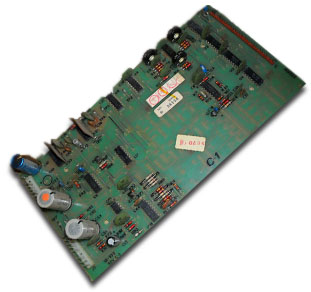
Date: 2/28/2011
12/4/2011 - fixed a few errors, mentioned c47 is a 220uf bipolar capacitor. Added some more tips on troubleshooting.
Introduction
This is a project page for the Stern SB-100 Sound Board. I created this page because I was unable to find much information on the SB-100 after searching on Google & the rec.games.pinball newsgroup. I have several early Stern pinball machines that use the SB-100 and the board is not functioning in several of the machines. This project is my attempt to understand the SB-100 board in more detail, figure out how to diagnose it and fix the current boards I have, and document my research.
Brief History of Stern
Stern began producing electronic pinballs in August 1977. Gary Stern with financial backing from his father (a prior president of Williams) bought out Chicago Coin in the mid-70s. The first pinball machine that was mass-produced by Stern in 1977 was called "Pinball" (I know, how imaginative). Many of the electronic boards Stern used early-on were actually copies of the Bally pinball boards. As the saying goes "Imitation is the sincerest form of flattery" and well, a lot of technology start-ups during the 70s and 80s copied successful designs to get a jump into the market. Bally of course didn't like this and sued Stern for infringement -- resulting in Stern paying a royalty to Bally for each game sold.
Stern's First Pinball Machines - Chime Sound
Sterns first 4 pinball machines had no electronic sound board. They instead used actual chimes. A solenoid with a plunger was located below these chimes and when the solenoid/coil was activated it would drive the plunger into the chime and cause the chime to ring. The MPU controls the solenoids like any other coil and the dip switches on the MPU board could be used to turn the chimes on or off.
"Chime" Sound
#101 - Pinball (Aug 1977)
#102 - Stingray (Dec 1977)
#103 - Stars (Mar 1978)
#104 - Memory Lane (Jun 1978)
Here's a picture of the chimes inside one of Stern's early pinball machines:
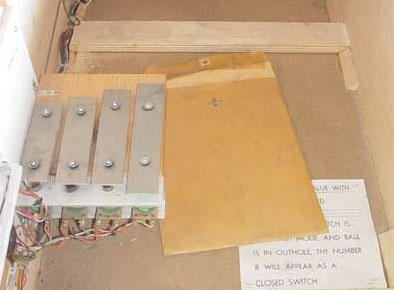
Picture: Chimes in a "Memory Lane"
Image Courtesy of Ken Kemp and Memory Lane page at IPDB.org
Stern's First Sound Card - The SB-100
After "Memory Lane", Stern used sound boards in most of their games. As far as I'm aware, the SB-100 was Stern's very first sound card used in a pinball machine and was not a copy of any of Bally's existing sound modules. Stern references this board as sound module part B-521.
SB-100 Sound Board
#105 - Lectronamo (Aug 1978)
#106 - Wild Fyre (Oct 1978)
#108 - Nugent (Nov 1978)
#109 - Dracula (Jan 1979)
#110 - Trident (Mar 1979)
#112 - Hot Hand (Jun 1979)
#115 - Magic (Aug 1979)
Multiple Board Versions
It should be noted that there are at three revisions/versions of the SB-100
used on these games. The first revision has circuitry for chimes + electronic sounds. The 2nd board lacks the circuitry for chimes, but still has the silkscreen drawings for all of the missing comonents. The 3rd board "Rev C-1" also lacks the chime circuitry and does not have the silkscreen drawings for the missing components. If using electronic tones, any version of these boards is compatible with the games listed above.. however only the boards that include the chimes circuitry can be used if setting the sounds on the game to "chime" mode. It's likely the boards with chime circuitry were only used in the first few electronic games produced to give operators the option to have the familiar chimes sounds or the new electronic sounds.
Also worth
noting is the frequency of the sounds on these boards is adjustable via
potentiometers r2, r6 and r13. These pots are used in the multivibrator
circuits along with LM324 and 4013 ICs. It's unknown at this time if the frequencies were adjusted per game title or if all games were dialed-in to the same frequency tones. If tones sound really bad, it's possible someone has played around with these potentiometers and made the sound less appealing in the process.
Lets look at the board differences further..
Comments:
| Stern Nugent Sound Board needed |
| Posted 05/03/12 1:53PM by nowears |
|
Please let me know when / if you have a stern sb-100 sound board available. My Nugent does not have one. Thanks, |
| Re: Anonymous Techdoser |
| Posted 12/31/11 2:41PM by AceBHound |
| Hi Bob, contact me via email on the "Contact Us" page on the left-hand navigation menu on this website. We can discuss details further. |
| Anonymous Techdoser |
| Posted 12/26/11 4:04PM by Anonymous Techdoser |
| Hi, Do you have an SB-100 for sale and how much? Would you give a discount for my non-working board? If not, how much to repair mine? Thanks, Bob |
| Re: Great Info |
| Posted 12/05/11 6:38PM by AceBHound |
| I may have an extra SB-100 available soon -- I'll email you. Also for anyone else interested, I will likely have more for sale down the road & entertain repairing some boards for people as time permits if they aren't severely hacked. Repair costs would depend on how "dead" your board is. Email is on my Contact page on this website. |
| Great Info |
| Posted 11/03/11 4:43PM by bobcav |
| This is great info. I'm currently looking for an SB 100 sound board as my Nugent machine has never had a board since I've owned it. Any thoughts on how to acquire one, either in working order or not? |
| Stern SB 100 sound board |
| Posted 03/10/11 8:24AM by Anonymous Techdoser |
|
what a great help! The test point voltages certainly gave me the confidence to make a repair to a Stern "Magic". I had replaced the chips in their entirety, capacitors, transistors, zenner diode and a couple of blown resistors. Until I found your voltage listing I could not have any confidence in the work I had done. I soon traced the problem to a cracked lead on the circuit board, in the voltage splitter prior to the amp chips. Thanks!!!! |