
Wiring Multiple LEDs
Author: Wayne Eggert
Date: 09/19/2009
Difficulty: Basic
Description
Now that we've covered wiring a simple led and how to hook that circuit up to a solderless breadboard, lets take a look at how to wire multiple LEDs to learn some additional things about electricity. We'll discover how wiring multiple LEDs in series is different from wiring the LEDs in parallel and how each affects the amount of current drained from the power source. You'll also quickly understand why old strands of Christmas lights with a loose bulb would cause the entire strand to go out.
Materials
(1) Solderless Breadboard (optional but makes it easier to experiment)
(3) 5mm LEDs (any color)
(3) 140ohm resistors (anything between 140ohm-400ohm should be fine)
(1) Battery Power Supply (I'm using a 6v supply via 4 AA batteries in a battery holder)
Series Verus Parallel
Electronic components can be wired in many configurations. Wiring in series and in parallel are very common and you'll likely use both when desigining circuits depending on the results you're looking for. You're limited only by the size of your power supply and the optimal operating voltages / amps of your components.
I always like relating something technical to objects in everyday life, so to illustrate the difference between Series versus Parallel we'll use a favorite kid's toy -- dominos! It won't be a very scientific view of series versus parallel, but it'll work.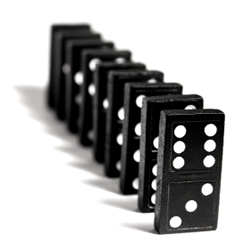
Dominos in Series
Dominos are a great toy, I never learned how to play the game, but I sure loved setting them up in rows and watching them fall! Now, picture a single row of dominos that stretches miles and miles. What happens if at any point in the row, a domino block falls wrong? GAME OVER!! Well, a single row of dominos is like wiring up electrical components in series. If any of those components fail, it can affect any other electronic components connected "in series" with the failing componenet. This is why old Christmas light strands with a loose or bad bulb would cause the entire strand to go out. The power stops at the failed bulb and it creates an open circuit!
Dominos in Parallel
Now, if you liked dominos as much as I did when I was younger, you've probably seen the domino competitions on TV where HUGE domino displays are created that require weeks or even months to setup. It wouldn't be very exciting if when they spent all that time setting up the dominos if 10 seconds in the dominos stopped falling. So the individuals setting up the dominos often plan for issues to occur and create two or three or four paths for the dominos to fork off. This not only makes it even more exciting to watch, but helps when something goes wrong with one of the paths. Well, that's exactly how the newer Christmas light strands are wired. If one light bulb is loose, it might not light, but all of the other bulbs will still light cause they are wired on a different path.
Lets take a slightly more scientific look at wiring LEDs in series and parallel..
page1 page2 page3Comments:
| HOW DO YOU WIRE A ROW OF UV LIGHTS? |
| Posted 09/11/13 8:38AM by jbing |
|
I am making UV Lights for Ghost Hunting. I cant seem to figure out how to wire them correctly. I cant get all the lights the light evenly, they all have a different brightness. here are the specs on the leds. DC Forward current=20mA Voltage=3.2-3.4 I am powering them with a 9volt batt. I have UV Leds in a box. Can any 1 help me wire them correctly? Thank You |
| wiring multiple led |
| Posted 03/13/13 8:56PM by treehuggerz |
| Hi I'm really new to this I'm trying to make a uv led writing board i want to use 9 uv leds 5mm each are 3.3 fw supply and 20 ma fw current im confused should i make 3 in each series and then run the sets of series in parallel or can i just run 9 leds in parallel i dont care how often. I have to change the battery.... also if you need 150 ohm resistance and you are running in parallel would you put 150 in front of each led or should you divide the resistance by how many leds you are using . Thanks so much for any help i have pictures of what I'm trying to do if that helps you help me :) |
| wiring multiple led diodes |
| Posted 02/01/13 8:40AM by mangrav |
| Hi, I have a rechargeable 2ft emergency twin ordinary tube light with 6v battery integrated. I want to remove the tube light and adjust it with 30 led diodes of 5mm, 20mA using the same circuit. Can you please help me in choosing the right resistors and making the wiring? |
| connecting blue uv led to insect zapper in lieu of uv tube lamp |
| Posted 04/12/12 10:08AM by kotakstreet |
| would be grateful if you can give me a circuit to connect 6 uv led working on 220v & 6v dc |
| Resistor before or after the LED |
| Posted 02/02/12 10:59AM by Anonymous Techdoser |
| It doesn't matter whether the resistor goes before or after the LED. The factor that burns out components is CURRENT, not VOLTAGE. The current through each loop in the circuit is the same whether the resistor is placed before or after the LED. |
| 3 L.E.D |
| Posted 10/03/11 3:53AM by ajaykumargaur |
|
Hi, I have seen some circuit in the market, which have 3 color chaning LED in series and the circuit is operated from 220 Volts. I have the same but the resistance inside it gets burn on inverter, can any one help on this? |
| Electron flow vs. Current flow |
| Posted 02/04/11 6:02PM by Anonymous Techdoser |
| To answer why the resistor is connected after the led is because of a misunderstanding of the flow of electricity before the electron was actually discovered, the electrons flow from negative to positive. So if you look at the schematic and follow the path from the negative terminal of the power supply - through the resistor - through the LED - back to the positive terminal of the power supply. |
| Resistor after LED |
| Posted 10/23/10 4:03AM by Anonymous Techdoser |
| Basically speaking current flows from negative to positive so the resistor is in front of the LED. |
| Will the required current be across each led? |
| Posted 06/29/10 10:32AM by Shoaib |
| I am in doubt about the current across each parallel diode. If the required current across each diode is 25mA, How can I maintain this amount of current across each diode? |
| why is the resistor connected after the led |
| Posted 06/05/10 3:02AM by try.myx |
|
as in your circuit diagram in the wiring multple led , why is the resistor connected after the led . isnt it supposed to be in front. now im in doubt. From the way i think and understand the resistor is used to minimise the voltage. so that the led will not recieve excess of voltage from burning it. please clear me the doubt . thnx in advance |